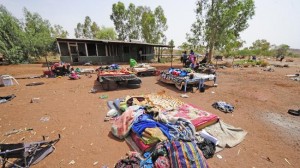
 Western Australia and the Northern Territory have the worst poverty and homelessness figures for First Peoples but WA and the NT are not only Australia’s wealthiest jurisdictions, they are among the world’s wealthiest. Meanwhile poverty among First Peoples has got worse than ever before and more extensive. Governments have claimed that they are finding ways to support impoverished First Peoples, and in supposedly spreading the wealth by supporting some into big business. But if this is true why is so much going wrong in these two jurisdictions where one would presume because of the levels of sovereign wealth so much should be going right?
Western Australia and the Northern Territory have the highest suicide rates in the nation among First People. One third of all suicides of First People occur in the Northern Territory. Western Australia’s Kimberley has among the highest suicide rates in the world. From a racialised lens, the Kimberley’s First Peoples endure the highest suicide rates in the world. Both these jurisdictions have the highest arrest and imprisonment rates of First Peoples. Eighty-six per cent of the Northern Territory adult prison population is comprised of First Peoples. In Western Australia, from a racialised lens, adult First Peoples are imprisoned at the world’s highest rate.
But according to the Office of the Registrar of Indigenous Corporations, mining is returning millions to Aboriginal owned corporations. Western Australia’s Pilbara is the engine room of the nation’s mining boom. But the two billion years old 400,000 square kilometres Pilbara is home to some pretty sad poverty, all of it First Peoples – Roebourne and Wickham for starters, and any of the cluster of communities around Marble Bar, Tom Price, Nullogine, Port Hedland.
Port Hedland is Australia’s busiest port, with ships leaving daily filled with iron ore extracted from Aboriginal land but with the profits returned to multinationals – next-to-nothing for the communities where many of the native title claimants live . Native title owners? A fool’s gold many say.
But if not billions of dollars there are millions of dollars going the way of Aboriginal corporations.
According to the Office of the Registrar of Indigenous Corporations, Western Australia’s Aboriginal corporations resulted in a total combined income of $502.7 million in 2012-13. Ironically, there has been a rise of Aboriginal corporate revenue while at the same time homelessness and poverty have become more acute and extensive, while jail and suicide rates have skyrocketed. South Hedland is skirted by some of the most deplorable poverty of First Peoples – shanties of despair, that break the hearts of those who visit them, of those people who do what they can to help the families languishing in third-world akin conditions. But, twenty-one Aboriginal corporations located in South Hedland have increased revenue by nearly 50 per cent between 2011-12 and 2012-13.
There is no legitimate blueprint of how the mining wealth should holistically lift communities out of poverty, how to help all of the people. Instead in a wild west like roadshow a trickle of the mining wealth is being tapped into for individual corporate benefit but not for holistic returns to communities. Native title is a debacle when everyone can see that the engine rooms of the mining wealth of this continent are failing holistically First Peoples communities. The Office of the Registrar of Indigenous Corporations does not deal in native title, it deals in governance and in the oversight of governance but the National Native Title Tribunal does deal in native title. The Federal Government does deal in native title. Exploratory licences and mining tenements are negotiated through the National Native Title Tribunal. This should have been the perfect instrument for a blueprint for ensuring benefits reach communities.
The average revenue of the 500 largest Aboriginal corporations for the financial year 2012-13 was $7.1 million, double the average income of the 500 largest corporations across the nation. Some have got wealthy, and that is fine if this is the way it was meant to be, but this is not the way it was sold. Instead of communities flourishing in the ways forward, in improving economic and social development, in their rise of the cultural tools, in the best of two worlds, many more people than ever before are hitting rock bottom, disenfranchised from both worlds. The idea of corporations doing the right thing by communities at all times, with a standard all should follow is just not happening. The idea that miners and this new layer of Aboriginal corporates that they will lift all of the people out of poverty and out of the corrals of human misery built by Australia’s apartheid has not occurred and will never occur. Land use payments, mining royalties, donations are so low that they were destined to fail, and when there is no surety of whatever little is agreed on is to be distributed holistically, equally then of course people will miss out. There have been more than 900 Indigenous land use agreements (ILUAs) and thereabouts 300 native title federal determinations. Where are we today? In worse poverty than ever before.
Western Australia ranked second to the Northern Territory for revenue earned by Aboriginal corporations. The 122 Northern Territory Aboriginal corporations accounted for nearly 30 per cent of the total national revenue. But for anyone who has visited the town camps – official and unofficial – which skirt just about every major town and region in the Territory, you could only come to the conclusion that native title, the mining booms, the fair go was not meant for everyone.
Western Australia’s mining boom may taper but it will not disappear anytime soon, but for far too many First Peoples it is as if it never occurred, except for the ghost towns and destruction of Country that the miners leave behind. But with the Northern Territory’s extreme poverty only getting worse the blueprint of native title needs urgent review. Of course this will not occur. Big business is fine with just the way things are, and Governments are pretty keen to keep moving people off Country and into the dustbowl corrals where myriad social ills fester.
The Territory is gaining international attention as a resource rich opportunity, but the majority of the one third of the Territory’s population – the First Peoples – they will miss out. The Fraser Institute’s annual survey of mining and exploration companies reported that the Northern Territory is on the brink of a mining boom. Territory Minister for mines and energy, Willem Westra van Holthe said that the Territory “topped Australia in the geological database category which ranks the quality and ease of access of Government geoscience.”
“Globally, we were ranked 6th out of 112 provinces in the Current Practices Mineral Potential Index which is based on the mineral potential under the current policy environment,” said Mr van Holthe.
The Northern Territory Government has invested more than $100 million in the last year in resources exploration. The Northern Territory’s homelessness rate, just about all of it First People, is at 730 per 10,000 according to the Australian Bureau of Statistics, while the national rate is 49 per 100,000. Australia-wide, the homeless rate for First People is at 200 per 10,000.
The crisis level rise in poverty, homelessness, imprisonment, suicide among First People cannot be addressed by the rise of Aboriginal corporate wealth. The rise in poverty, homelessness, imprisonment, suicide is also in huge part the result of the rapacious mining and in huge part the result of the weaknesses of the Native Title Act and of the National Native Title Tribunal. Far too many communities are pushed around, closed down, moved off their Country into corrals, and then ripped off by both Governments and miners. Then they are let down by Aboriginal Corporations which have assimilated into highly paid executives and predominately self-serving organisations. The blueprint should be one where it is a must-do to deal with the communities as a whole, where benefits are returned holistically and immediately to all of the people. This is not simplistic. It is the way it should be.
People should not have to go cap in hand to their native title prescribed body corporates, to Aboriginal corporations, with head bowed, and beg for money for fuel and food.


Mining is one of the saddest things ever